
Veteran Spotlight: William Otto Kustenborder
Updated: Nov 11, 2025
Spanish American and Philippine Wars, Private Co. H 1st NE Inf

William Otto Kustenborder was born on March 4th, 1879 in Centre County, Pennsylvania to Levi and Susanna Kustenborder. William had 12 siblings but only four of them would survive into adulthood and although he was not the only son, he was the only one to make it out of infancy. In 1882 William, or Otto as he was often called, moved with his family to a farm about five miles south of Nelson, Nebraska. He was just 3 years old at this time so it's likely that Nuckolls County is the only home he had any memory of. He most likely attended the country school just a couple miles from his family's farm.
The 1st Nebraska Infantry was made up of two regiments of the Nebraska National Guard who were called up to federal service at the outbreak of the Spanish American War. So it is not known if Otto had any plans of foreign travels when he joined or whether he was simply hoping to collect a few dollars for training and in-state duties. Regardless of his goals or motivations he found himself mustered into the United States Army on May 10th, 1898 as a private in Company H. The company was made up almost entirely of Nuckolls County men with the exception of Frank Eager who was transferred from Company D and commissioned Captain when Captain Baldwin did not pass physical inspection. Frank would go on to write the History of Operations of the First Nebraska Infantry, U.S.V. in the Campaign in the Philippine Islands.
On May 16th Otto and the rest of Company H departed on the Union Pacific for San Francisco in preparation for shipping out to Manila. It was certainly not a comfortable train ride since it was a three day trip and the men were only provided with day cars. Even so, it must have been exciting for a farm boy who knew only the desolate plains to travel across the diverse landscapes of Wyoming, Utah, Nevada and California. From Frank's History of Operations, “All along the route the troops were greeted with enthusiasm by young and old. At every station there was a large crowd, with banners and flags, bunting, flowers, sandwiches, coffee, cigars, and fruit of all descriptions. At some stations, where the coming of the regiment was known, there were bands, drum corps, quartets and singing societies. In California, at several stations, school children attended by their teachers, greeted the soldiers with patriotic songs and wished them God speed. Many touching scenes were enacted, and many a souvenir exchanged. A musician, who afterwards became the chief trumpeter, had 387 hairpins when he reached San Francisco, the owner of each of which he had promised faithfully to write all about Manila and the Philippines.”

During the three weeks Otto and his company were encamped at San Francisco, they drilled, enjoyed the hospitality of the locals and saw the sights of the bay area. It must have been quite the change of pace from their homes in Nuckolls County. Then on June 14th they were ordered to break camp and march to the steam ship Senator and by the next morning they had begun the voyage to Manila. From Frank's History, “Seafaring is a novel experience, and to the uninitiated somewhat embarrassing. There is no remedy for seasickness, and if there were, the doctors, stewards and hospital men would not be able at all times to administer it. The best remedy is to "hang over the railing of the ship until you get well," says Governor Hogg of Texas. Almost every one became seasick, even the Colonel. An officer found him one evening, standing on the bridge, and, as he thought, gazing out over the waves. The shadow of the waves hid him partially, and when the officer asked him if the moon was up, he somewhat angrily replied. —" No, I didn't swallow the moon." The rations were unsatisfactory; the canned meats were not liked by the men and there was no taste to the coffee; all that can be said of it is that it was wet.”
On June 24th the 1st Nebraska was allowed a brief shore leave at Honolulu where they were served an elaborate lunch on the lawn of the palace and then sailed on the next afternoon. On July 17th after just over a month at sea, they arrived in Manila Bay and the sight-seeing portion of the deployment was decidedly over.
According to Frank “The disembarkation was a rather slow process. There were only a few cascoes, in which men and baggage were taken from the ship to within fifteen to thirty feet to the shore, and here the men had to wade in water, waist deep, carrying their rifles and their other equipments. Filipinos carried the officers over on their backs.” Upon their arrival the Americans discovered that the Filipinos had already encircled most of the city with trenches and Uncle Sam's boys quickly set to work finishing the job. “The work of building trenches was severe, but, although there was occasional desultory firing along the lines, there was no serious fighting until the night of July 1st, when there occurred what is known as the " Battle in the Rain," when a conflict beginning at the outposts, developed into what was thought to be a serious attack from the enemy. The night was dark and very stormy, and it has never been possible to ascertain exactly what did take place in the darkness, but all the troops were called out, and the firing was very brisk for some hours. On that night the regiment was called out and placed in reserve, but after standing in line several hours in the rain, was ordered back to quarters.”
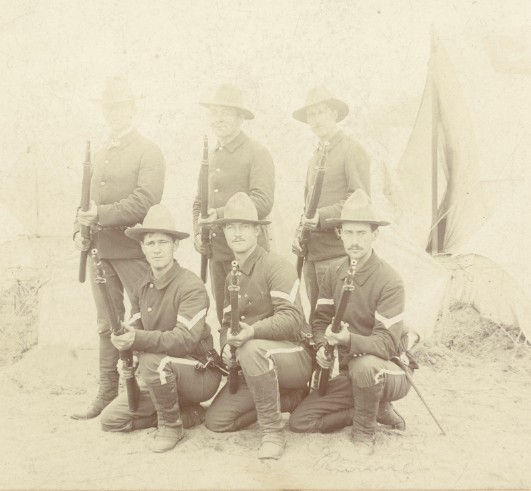
On August 2nd the regiment shed its first blood when Private William Lewis, of Company E, was killed, a shell literally blowing his head off. Seven enlisted men were also wounded but Company H escaped unscathed. On August the 5th, the regiment was again under fire. The water in the trenches was knee-deep, making for a miserable night. “On August the 13th, the regiment fought with General Greene's Brigade, assisted in taking Fort Malate, took possession of the public buildings and shipping along the Pasig River, and pressed on toward the Walled City, wading waist-deep in the surf. Upon reaching the Luneta, the troops perceived the milk-white flag floating over the ramparts of those ancient walls. Manila had surrendered! The first American flag was raised by Major Mulford near the Captain of the Port's office, in the presence of Generals Greene and H. G. Otis, two Spanish officers, and the whole Nebraska Regiment. An excited Spaniard, who saw what was being done, came running to prevent the Spanish flag from being hauled down; when gently removed he burst out in a rage and cried as though his heart would break.” And so, the war with Spain was over but Otto and company would not be going home just yet.
President McKinley took the position that returning the Philippines to Spain would have been “cowardly and dishonorable,” that turning them over to “commercial rivals” of the United States would have been “bad business and discreditable,” and that the Filipinos “were unfit for self-government.” So the Philippines would remain occupied by their so-called liberators. By September disease was rampaging through the ranks and outbreaks of typhoid, measles, meningitis, malaria and dysentery were reducing forces to the point that at times companies would have only one or two present at morning roll call. Then on October 12th Company H suffered its first casualty, Private Albert Burd died of typhoid. Another member of the company, Private Homer Seeley, is recorded to have died of dysentery on October 23rd.
In early December the regiment was ordered to move camp to Santa Mesa which caused much grumbling amongst the men but according to Frank's account they made the best of it. “The camp was situated on an old Spanish battle-ground on a hill near the McLeod residence. The field had been terraced for growing rice, and was covered with water from three to four inches deep. From appearance it seemed impossible that such a field of mud and water could be converted into the beautiful and pleasant camp that it was. Almost immediately after the regiment was stationed here the dry season set in, and from the early part of December until the outbreak on the 4th of February, the First Nebraska maintained a "model camp," which every officer and soldier took great pride in keeping up to the highest ideal. The location was high and suitable. Two men only were assigned to a tent, to prevent crowding. The Government furnished bamboo floors. These were placed on bamboo stilts about two feet from the ground. Each tent had two bamboo beds about two feet high. These precautions were taken to prevent fever. Pipes were laid in the camp to give each company a supply of pure water from the reservoir nearby, and in the rear of each company kitchen a tent was erected containing tubs and arrangements for bathing. The officers of other regiments often complimented the Nebraskans on possessing such a fine camp, declaring it to be one of the prettiest white cities over which the American flag was ever floated to the breezes.”
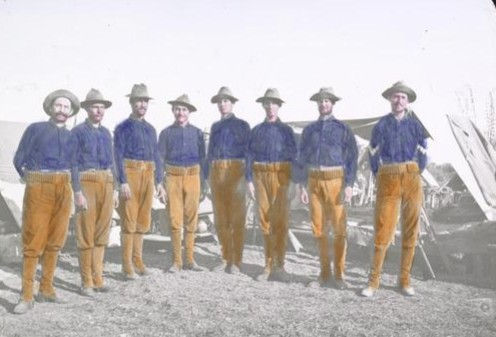
Camp Santa Mesa was located between block-houses Number 7 and 8, four miles from Manila, near the San Juan River, and was the furthest point in the line of entrenchments from the city. This move put the 1st Nebraska in close proximity to the Filipino revolutionaries as tensions were beginning to escalate. While diplomatic relations were breaking down between the Americans and the newly created Philippine Republic, the soldiers of both sides were getting more and more irritated with each other. On February 4th, 1899 Private Grayson of the 1st Nebraska Company D struck the spark that ignited the powder keg.
Grayson’s account is considered dubious but nevertheless here is his explanation of events. “That night, about 8 o'clock, Miller and I, there were two of us, were cautiously pacing our district. We came to a fence and were trying to see what the Filipinos were up to. Suddenly, near at hand on our left, there was a low but unmistakable Filipino outpost signal whistle. It was immediately answered by a similar whistle about twenty-five yards to the right. Then the red lantern flashed its signal from blockhouse 7. We had never seen such a sign used before. In a moment something rose slowly up, not twenty feet in front of us. It was a Filipino. They were evidently moving dangerously near. I yelled 'Halt!' and I made it pretty loud, for I was accustomed to challenging the officer of the guard in approved military style. The man moved. I challenged him with another loud 'Halt !' Then he impudently shouted 'Halto' at me. Well , I thought the best thing to do was to shoot him. He dropped. If I didn't kill him, I guess he died of fright. Then two Filipinos sprang out of the gateway about fifteen feet from us. I called 'Halt ! ' and Miller fired and dropped one. I saw that another was left. Well, I think I got my second Filipino that time . . . We then retreated to the pipe line and got behind the water main and stayed there all night. It was some minutes after our second shots before the Filipinos began firing, but then they made up for it by a fusillade that showed they had been prepared for their boasted advance.”
The first shots of the Philippine American War had been fired and the Battle of Manila began. The official report of this engagement is as follows: “The regiment under Colonel J. M. Stotsenburg was ordered into line as previously arranged for, from the village of Santol, between camp and San Juan River, to block-house No. 8, which line they held until daybreak and then, led by its officers, advanced and took block-houses Nos. 6 and 7 on the left, and to the San Juan River on the right, crossed the bridge and took the Powder Magazine under heavy fire. After dislodging the enemy, advanced to Water Deposito on San Juan Del Monte hill. Monday February 6th, at about one o'clock advanced along water-pipe road under continual fire and took Pumping Station on the Mariquina River.” Harry Seabrook was wounded in the right breast and was the only casualty for Company H in the battle.
For the rest of February Otto and the rest of his company participated in skirmishes in and around Mariquina which culminated in the burning of the city on February 25th. The company's musician, William Disbrow, was wounded in the thigh during this fighting. Then the company received a bit of cheer from home which was much appreciated even if it was a bit late. From Frank's History, “The Christmas boxes arrived about 12 o'clock, March 3d, and a happier crowd of boys was never seen. The boys all hoped that they could have their next Christmas dinner at home, and not have it delayed until March 3d.”
On the 25th of March the advance towards Malolos began. The 1st met considerable resistance but advanced steadily. On the evening of the 27th they were setting up camp when the Filipino forces decided to attack. “Seeing the natives so close, over a bank they jumped, and with a yell, and without orders, charged on that mass of insurgents, who immediately turned and ran for their lives. The whole regiment was in the charge, Major Mulford commanding the right and Colonel Stotsenburg the left. The Color Sergeant unfurled the flags and the boys rushed after the enemy with flying colors, some squads firing volleys, and every individual man firing as fast as he could, taking a pot shot at every Filipino who showed himself. The Nebraskans chased them over two miles, killing and wounding many at ranges from 200 to 1200 yards… It was during this engagement that General Hale remarked: "There go those Nebraskans again, and all hell couldn't stop them."
On the 29th Otto was wounded in the neck near Guiguinto. He was evacuated to the First Reserve Hospital in Manila, possibly on one of the four mule-drawn ambulances in the hospital's service. At that time anesthetics were crude and surgery would have been performed with patients still semi-conscious. Otto was lucky enough to survive his injury and would spend the next couple weeks convalescing before returning to his unit on April 15th.

Upon his return Otto found the Nebraska boys in Mololos, which they had successfully captured in his absence. At 3am on the morning of April 23rd a scouting party and the 4th cavalry, led by Major Bell, found themselves surrounded and pinned down by Colonel Tescon’s forces near Quingua. Bell recognized his position was badly exposed and called for reinforcements. The Nebraskans were the first to respond and arrived ahead of their Colonel, John Stotsenburg, who was delayed in Manila. Our friend and primary source for this article, Captain Frank Eager, recently promoted to Major, took command of companies A, D, F and H and moved to assist Bell. “Major Eager's Battalion came up with Major Bell, who had determined to extricate himself from the trap. Companies D and H pushed forward on the right, and A and F on the left of the road in skirmish line. Companies D and H cleared the bamboo and marched into the open, passing a ditch that would have afforded them shelter. The two companies had covered 200 yards of the opening, when suddenly the woods belched forth fire and smoke. Every man dropped with his face on the damp ground. They had never seen such marksmanship. In reply our men fired volleys, necessarily ineffectual, serving only to draw ahotter and closer fire from the enemy. The troops contented themselves with lying low, sweltering in the sun and fainting from heat and thirst. There they lay under fire for two hours. Several were sunstruck, one dying from the effects of the heat while lying there, with not a sign of artillery to rescue them from their perilous position. Many were wounded while attempting to carry back their sunstruck or wounded comrades. The groups about the prostrate form presented a favorable mark to the enemy.”
“Companies A and F were having a warm time on their side of the road, but they were under cover. Companies M, I, B and K were brought up and lodged behind D and H, but under cover of the ditch. General Hale had sent for artillery and was putting it in position. It soon opened fire but every moment the men were succumbing to the heat. Lieutenant Hansen, commanding Company D, was in advance with several men. They attempted to move back. Hansen was too exhausted to rise. A man raised him by the arm, but fell shot through the back. Three others were wounded in getting these men from the field. The hours wore away. Many felt death preferable to their sufferings. Colonel Stotsenburg arrived at Malolos and hearing that his regiment had gone forward, he mounted his horse and rode up to General Hale near the artillery. It is said General Hale ordered him to recall his men which he refused to do. Hastening to the lines, he replied to the General's orders to come back:—"My place is with my men." As he came across the field with his conspicuous figure in the familiar brown coat and helmet, a wild cheer from the whole line greeted him. The enemy's fire focused upon him. The men were aghast as the bullets tore around him, before and behind, between his feet and above his head. His life seemed charmed, for he reached the ranks untouched. "Forward" was his order. The reserve ran ahead to the exhausted survivors of the three hours' fire. Advancing slowly at a walk, the entire line of the concealed trenches, twice the length of the assailing front, quivered with the roar of the fire and cross-fire upon the American line.”
“Eight companies of the regiment, numbering less than 300 men, 218 having been killed and wounded in previous engagements, faced the works which the whole brigade intended charging on the morrow. The enemy's fire was ten times hotter than before. Every man thought each moment his last, but resolutely pushed ahead. The flights of the bullets were like a din of shrill yelling. Sometimes the men paused to fire volleys. The Colonel admonished them to keep down. He thought of no danger for himself. He thought of his men first. On again the advance continued, the distance to the final charge narrowing, but the thin line growing thinner. Sergeant Stoner of Company D, was hit in the jaw. He reeled and dropped his gun. The Colonel picked it up and went on. Just then a bullet struck Colonel Stotsenburg in the chest. The brave leader cried: "Go on, boys!" threw up his hands, fell upon his face, and perished within 100 yards of the trenches of the enemy. The men were nearly insane. Over the last one hundred yards their charge was furious. The enemy left the trenches in hot haste. Over the walls the Nebraskans went. The field before the trenches looked like a slaughter pen. One hundred brave soldiers, dead, wounded and exhausted, were lying there.”
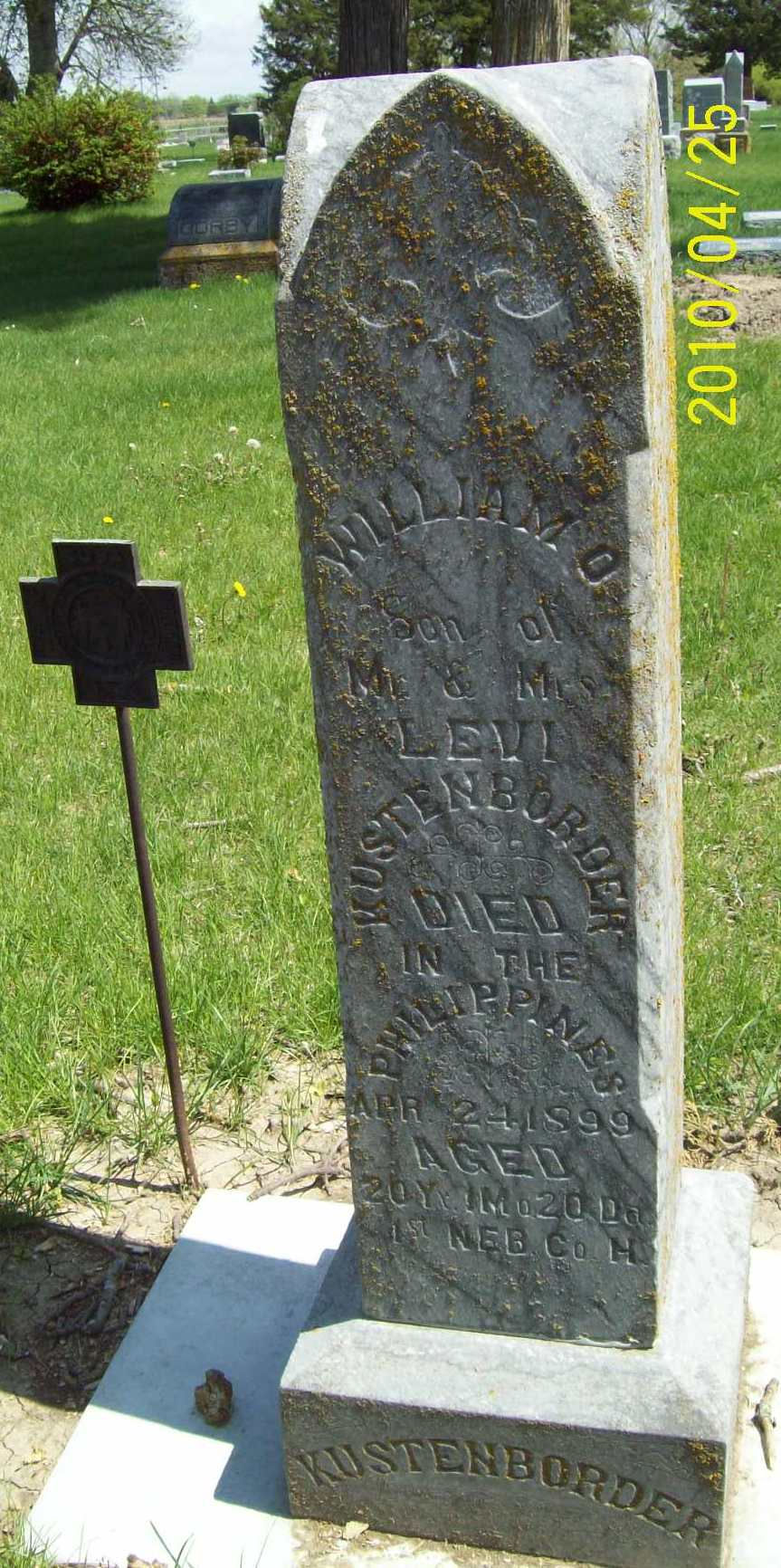
Among the wounded was Otto, this time shot in the stomach. He was once again removed to the First Reserve Hospital but his wound was greater than the abilities of the surgeons. On April 24th, 1899 the only living son of Levi and Susan Kustenborder slipped away. He was just 20 years old. He returned to Nuckolls County for his eternal rest and can be visited at the Nelson Cemetery. Thank you for your service and your sacrifice Private.


Comments